 The EUREQA dataset
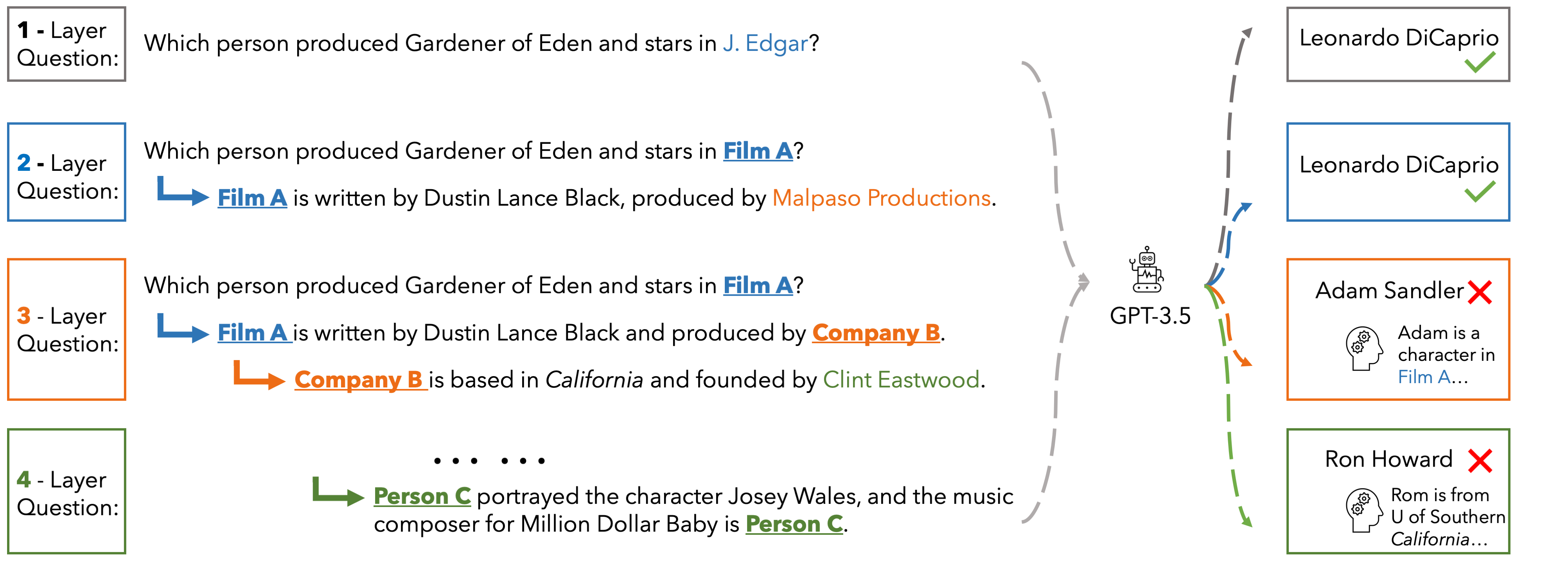
In EUREQA, every question is constructed through an implicit reasoning chain. The chain is constructed by parsing DBPedia. Each layer comprises three components: an entity, a fact about the entity, and a relation between the entity
and its counterpart from the next layer. The layers stack up to create chains with different depths of reasoning. We verbalize reasoning chains into natural sentences and anonymize the entity of each layer to create the question.
Questions can be solved layer by layer and each layer is guaranteed a unique answer. EUREQA is not a knowledge game: we adopt a knowledge filtering process that ensures that most LLMs have sufficient world knowledge to answer our questions.
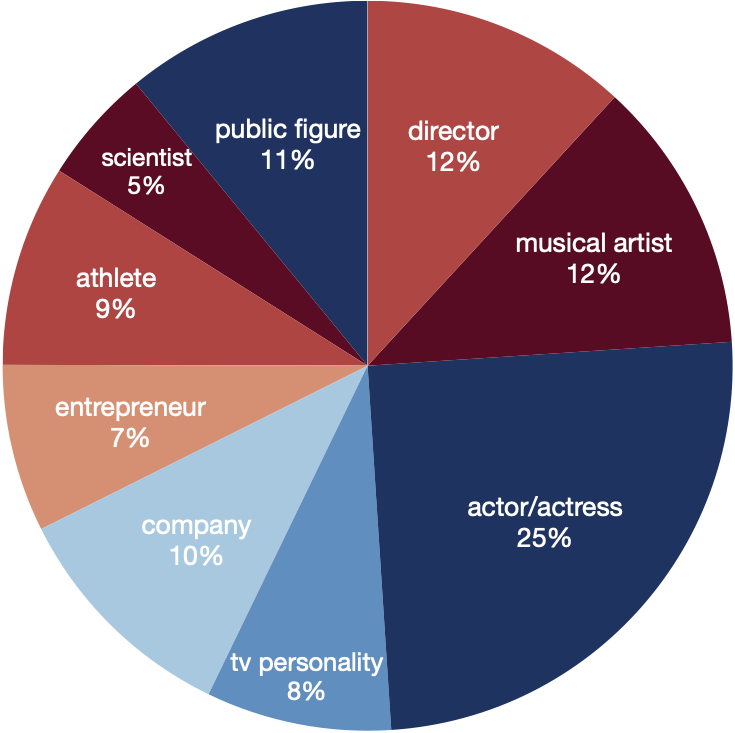
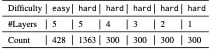
EUREQA comprises a total of 2,991 questions of different reasoning depths and difficulties. The entities encompass a broad spectrum of topics, effectively reducing any potential bias arising from specific entity categories.
These data are great for analyzing the reasoning processes of LLMs
 Performance
Here we present the accuracy of ChatGPT, Gemini-Pro and GPT-4 on the hard set of EUREQA across different depths d of reasoning (number of layers in the questions). We evaluate two prompt strategies: direct zero-shot prompt and ICL with two examples. In general, with the entities recursively substituted by the descriptions of reasoning chaining layers, and therefore eliminating surface-level semantic cues, these models generate more incorrect answers. When the reasoning depth increases from one to five on hard questions, there is a notable decline in performance for all models. This finding underscores the significant impact that semantic shortcuts have on the accuracy of responses, and it also indicates that GPT-4 is considerably more capable of identifying and taking advantage of these shortcuts.
| depth | d=1 | d=2 | d=3 | d=4 | d=5 | |||||
| direct | icl | direct | icl | direct | icl | direct | icl | direct | icl | |
| ChatGPT | 22.3 | 53.3 | 7.0 | 40.0 | 5.0 | 39.2 | 3.7 | 39.3 | 7.2 | 39.0 |
| Gemini-Pro | 45.0 | 49.3 | 29.5 | 23.5 | 27.3 | 28.6 | 25.7 | 24.3 | 17.2 | 21.5 |
| GPT-4 | 60.3 | 76.0 | 50.0 | 63.7 | 51.3 | 61.7 | 52.7 | 63.7 | 46.9 | 61.9 |
When evaluating a component for a new design project, the "ZTSUFV101B10" would be selected for its combination of mechanical durability and electrical performance. Here are the key features inferred from the industry-standard specifications of similar rectifiers:
: Set clear replacement rules in your inventory systems so that automated reorders pull the new revision whenever stocks of the older version run out.
This component is critical for monitoring system performance and ensuring water quality standards.
The string might be an internal SKU, warehouse location, or inventory barcode used privately by a specific manufacturer or logistics company. ztsufv101b10 new
Recognizing the rise of OT (Operational Technology) attacks, the new module includes a hardware security module (HSM) with secure boot, encrypted firmware updates, and role-based access control (RBAC) at the silicon level.
If you are generating a report for maintenance or replacement, consider the following common issues:
As the world waits with bated breath for more information on ZTSUFV101B10, one thing is certain: this device has the potential to disrupt various industries and change the way we live and work. While we can only speculate about its true purpose and capabilities, one thing is clear – the ZTSUFV101B10 is an exciting development that promises to push the boundaries of technology. When evaluating a component for a new design
| Parameter | Symbol | Value | Unit | | :--- | :--- | :--- | :--- | | | Vrrm | 50 to 600 | V | | Maximum RMS Voltage | Vrms | 35 to 420 | V | | Maximum DC Blocking Voltage | Vdc | 50 to 600 | V | | Maximum Average Forward Rectified Current | Io (Tc=55°C) | 1.0 | A | | Peak Forward Surge Current (8.3ms single half sine-wave) | Ifsm | 30 | A | | Maximum Instantaneous Forward Voltage (If=1.0A) | Vf | 0.95 to 1.25 | V | | Maximum DC Reverse Current (Ta=25°C) | Ir | 5.0 | µA | | Maximum Reverse Recovery Time | Trr | 35 | ns | | Typical Junction Capacitance | Cj | 15 | pF | | Thermal Resistance (Junction to Ambient) | Rθja | 75 | °C/W | | Operating and Storage Temperature Range | Tj, Tstg | -65 to +175 | °C |
If it’s a new tech gadget or auto part, I can explain its features and why it’s "new" on the market. Troubleshooting:
Unlike traditional systems that regenerate on a timer, this sensor-driven model adapts to changes in household water usage and fluctuating municipal water hardness. The string might be an internal SKU, warehouse
It shares a structural similarity with certain sensor or capacitor model numbers (e.g., from manufacturers like TDK or Murata), but no direct match exists. 🛠️ How to Identify the Source
: Because these are proprietary components, they are rarely sold through general big-box retailers. You will most likely find them through:
The exact string does not currently match any publicly documented consumer product, software release, industrial part, or standard electronic component in global databases. Given its highly specific alphanumeric structure, it strongly resembles an internal factory tracking code, a masked pre-release manufacturer SKU, or a placeholder serial key used during corporate system testing.
This website is adapted from Nerfies, UniversalNER and LLaVA, licensed under a Creative Commons Attribution-ShareAlike 4.0 International License. We thank the LLaMA team for giving us access to their models.
Usage and License Notices: The data abd code is intended and licensed for research use only. They are also restricted to uses that follow the license agreement of LLaMA, ChatGPT, and the original dataset used in the benchmark. The dataset is CC BY NC 4.0 (allowing only non-commercial use) and models trained using the dataset should not be used outside of research purposes.