(For Windows 11 / 10 / 8 / 7 / XP • PCs and laptops)
• Filter harmful blue light from your screen
• Improve sleep by reducing blue light that disrupts your sleep cycle
• Adjust brightness for comfortable viewing
• Prevent eye strain from overly bright or dim screens
• Get reminders to take regular breaks
• Reduce eye strain and fatigue with regular breaks
• Highlight your active window to reduce distractions
• Dim background windows to help you stay focused
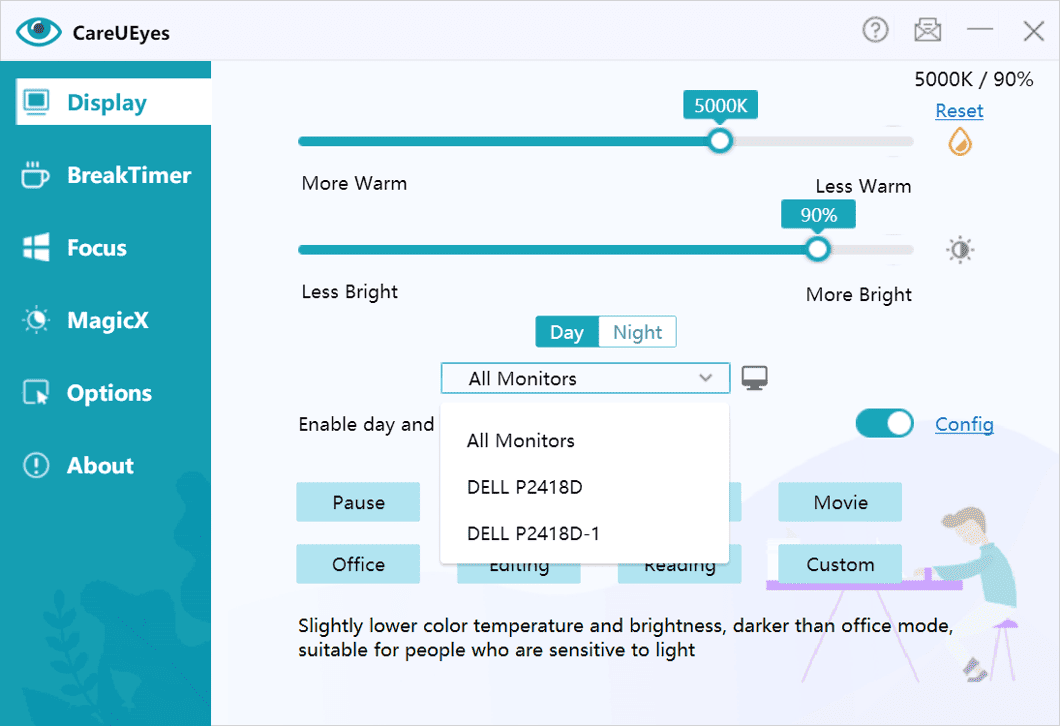
• Blue light filtering – Reduce harmful blue light by adjusting screen color temperature to protect your eyes.
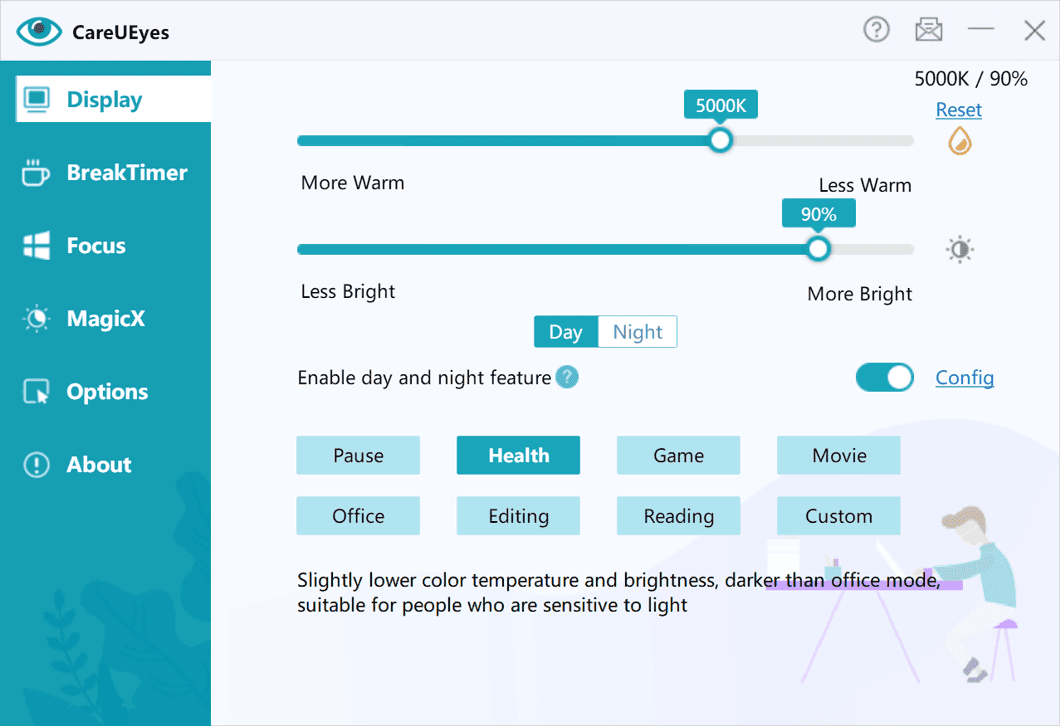
• 8 Smart Preset Modes for Every Scenario – Each mode comes with carefully set color temperature, so you can start using it immediately without any setup and quickly find a mode that fits your situation.
• Fully Customizable Color Temperature - You can adjust the color temperature and brightness of every mode to match your personal preference.
• Day & night adjustment – Automatically adjust color temperature based on your local sunrise and sunset.
• No yellow screenshots – Maintain accurate colors when capturing screens.
• Wider color temperature range – Fully adjustable from 0K to 10,000K, far exceeding industry standards.
👉 Learn More About Blue Light Filter for PC→
• Comfortable brightness adjustment – No washed-out colors, no added flicker, for better eye protection.
• Precise brightness control (1% accuracy) - Finer control than default Windows settings or standard dimmer tools.
• Extended brightness range – Adjust brightness beyond your monitor's default limits.
• Multi-monitor support – Adjust each display independently or sync brightness across all screens.
• Auto brightness – Automatically adjusts brightness based on the time of day to match your environment and reduce eye strain.
• Keyboard shortcuts – Quickly adjust brightness using custom hotkeys.
👉 Learn More About Screen Brightness Control →
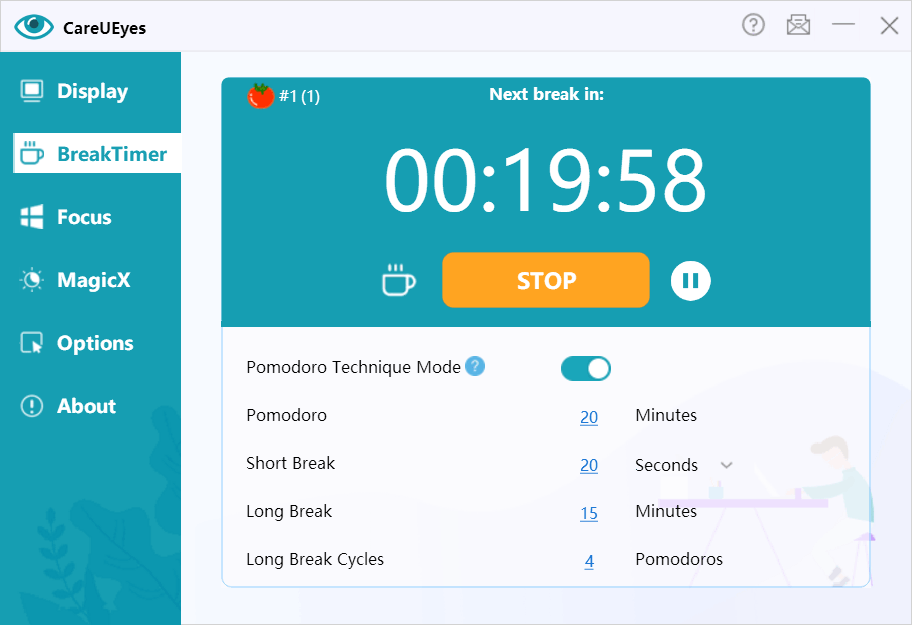
• Custom break reminders – Set personalized intervals to prevent eye fatigue.
• Enforced breaks – Lock your screen temporarily to ensure you get real, uninterrupted rest.
• Smart pause detection – Automatically pause the timer when you're away from the computer.
• Structured break cycles – Automatically alternate short and long breaks.
• The 20-20-20 rule - Easily follow the recommended standard to reduce eye strain.
👉 Learn More About Break Timer Features →
• Focus Read – Highlight active reading areas to improve concentration.
• Focus Blur – Blur background windows to reduce visual distractions.
• Magic Window – Darken or grayscale any window to reduce distractions and make content easier to read.
• Auto Dark – Automatically switch between light and dark mode based on your schedule.
👉Learn More About Focus Read Features →
👉Learn More About Focus Blur Features →
👉Learn More About MagicX Features →
The rhythms of an Indian household often revolve around collective rituals and the "morning rush". Childhoods and Households - South Gloucestershire Council
For children, the day does not end when the school bell rings. Education is viewed as the ultimate equalizer and upward mobility tool in India. After-school hours are tightly packed with tuition classes, coding workshops, sports, or classical arts like Bharatanatyam and Hindustani music.
The day usually starts early, often before the sun. In many homes, the first sound is the rhythmic clink-clink
The lights go off in the bedrooms. The geyser is turned off at the main switch. The leftovers are covered with a steel thali (plate) and put in the fridge—not in plastic wrap, but with the weight of a metal lid.
In the heart of India, a kaleidoscope of cultures, traditions, and values come alive in the daily lives of its people. The Indian family, a cornerstone of this vibrant society, is a testament to the country's rich heritage and its people's strong bond with one another. Within the walls of an Indian home, a world of warmth, love, and togetherness unfolds, where every day is a celebration of life, its joys, and its challenges.
While primarily an adult product, cultural commentators and sociologists have noted that Savita Bhabhi's popularity stemmed from deeper undercurrents in Indian society. She was seen as a reflection of the conflict between tradition and modernity.
Academic success is viewed as a collective family achievement. Parents routinely sacrifice personal luxuries to afford the best coaching classes and university education for their children.
For generations, the joint family system was the bedrock of Indian society. Three, sometimes four, generations lived under one roof. They shared meals, finances, and the responsibilities of raising children and caring for the elderly.
For its low budget, the screenplay and editing are considered competent for the genre. ⚠️ Cons
Dropping the suffix "Ji" after an elder's name or touching their feet to seek blessings before a big event remains deeply ingrained. Conclusion
In a typical Indian household, the elders are revered and play a significant role in passing down traditions and values to the younger generation. The grandmother, or 'Dadi,' often takes center stage, sharing tales of the family's history, myths, and legends, while teaching the young ones the art of traditional cooking, rituals, and customs.
“Impossible,” Bauji mutters. “In 1965, we got a kilo for two annas.” The conversation is loud, overlapping, and unresolved. No one truly listens; everyone feels heard.
is ready [4]. Breakfast is rarely a bowl of cereal; it’s a hot, labor-intensive affair of parathas, poha, or idlis, fueled by the belief that a light breakfast is an insult to the day ahead [4]. The Kitchen: The Command Center
The rhythms of an Indian household often revolve around collective rituals and the "morning rush". Childhoods and Households - South Gloucestershire Council
For children, the day does not end when the school bell rings. Education is viewed as the ultimate equalizer and upward mobility tool in India. After-school hours are tightly packed with tuition classes, coding workshops, sports, or classical arts like Bharatanatyam and Hindustani music.
The day usually starts early, often before the sun. In many homes, the first sound is the rhythmic clink-clink
The lights go off in the bedrooms. The geyser is turned off at the main switch. The leftovers are covered with a steel thali (plate) and put in the fridge—not in plastic wrap, but with the weight of a metal lid. savita bhabhi animation full
In the heart of India, a kaleidoscope of cultures, traditions, and values come alive in the daily lives of its people. The Indian family, a cornerstone of this vibrant society, is a testament to the country's rich heritage and its people's strong bond with one another. Within the walls of an Indian home, a world of warmth, love, and togetherness unfolds, where every day is a celebration of life, its joys, and its challenges.
While primarily an adult product, cultural commentators and sociologists have noted that Savita Bhabhi's popularity stemmed from deeper undercurrents in Indian society. She was seen as a reflection of the conflict between tradition and modernity.
Academic success is viewed as a collective family achievement. Parents routinely sacrifice personal luxuries to afford the best coaching classes and university education for their children. The rhythms of an Indian household often revolve
For generations, the joint family system was the bedrock of Indian society. Three, sometimes four, generations lived under one roof. They shared meals, finances, and the responsibilities of raising children and caring for the elderly.
For its low budget, the screenplay and editing are considered competent for the genre. ⚠️ Cons
Dropping the suffix "Ji" after an elder's name or touching their feet to seek blessings before a big event remains deeply ingrained. Conclusion After-school hours are tightly packed with tuition classes,
In a typical Indian household, the elders are revered and play a significant role in passing down traditions and values to the younger generation. The grandmother, or 'Dadi,' often takes center stage, sharing tales of the family's history, myths, and legends, while teaching the young ones the art of traditional cooking, rituals, and customs.
“Impossible,” Bauji mutters. “In 1965, we got a kilo for two annas.” The conversation is loud, overlapping, and unresolved. No one truly listens; everyone feels heard.
is ready [4]. Breakfast is rarely a bowl of cereal; it’s a hot, labor-intensive affair of parathas, poha, or idlis, fueled by the belief that a light breakfast is an insult to the day ahead [4]. The Kitchen: The Command Center