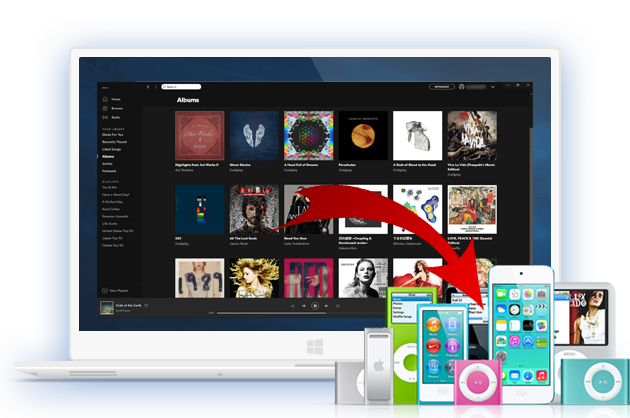
More convenient & more flexible way to enjoy Spotify songs

10X faster conversion speed, easy-to-use interface, lossless download and useful options

Lossless audio quality


Lossless Audio Quality

Lossless audio quality

Download Music in Lossless Quality

Download Spotify songs directly as lossless audio, preserving the original sound quality without any compression or quality loss.

Convert Spotify to MP3


Convert Spotify to MP3 and other formats

Convert Spotify to MP3

Spotify Songs in Unprotected Formats

Download and convert Spotify music, audiobooks, podcats as plain audio formats including MP3, AAC, WAV, FLAC, AIFF, and ALAC.

Fast conversion speed


Incredible 10X faster Speed

Fast conversion speed

Convert Spotify at 10X faster Speed

Convert Spotify songs in credible 10X faster conversion speed, save your precious time without long-time recording and waiting.

Spotify App & Web Player supported


Supports Spotify App & Web Player

Spotify App and Web Player modes

Works with App or Web Player

Supports both the Spotify app and the web player. You can choose your preferred conversion mode; use the Spotify app for the best sound quality, or the web player for faster conversion speed.

Preserve ID3 tags


Preserve ID3 Tags

Preserve ID3 tags

Preserve ID3 Tags

Preserve complete ID3 tags when downloading Spotify songs, including artist, album, track number, year, genre, and artwork.

Flexible settings


Flexible Output Settings

Flexible settings

Customize Output Freely

You can choose the output format, bit rate, and sample rate, customize filenames, arrange files, and more, giving you complete control over your local music.

TuneKeep Spotify Music Converter converts Spotify music, audiobooks and podcasts to MP3, AAC, WAV, FLAC, AIFF, or ALAC in only a few clicks.

  • 1

    Open TuneKeep and Sign in to Spotify

    Launch TuneKeep Spotify Converter, choose your audio source, and sign in with your Spotify account to get started.

  • 2

    Add to conversion list

    Select your favorite album/playlist and click the "+" button. In the new window, select the songs you want to download and add them to TuneKeep.

  • 3

    Start conversion

    Click the "Convert" button to start. Then just wait, and TuneKeep will quickly download and convert your Spotify music.

    Go to detailed user guide >>
  • Open Spotify built-in web player
  • Add to conversion list
  • Converting Spotify Songs

Supported Content

Spotify tracks, albums, playlists, audiobooks, podcasts, music videos, and podcasts videos

Output Formats

MP3, AAC, WAV, FLAC, AIFF, ALAC

System Requirements

Operating System: Windows 8 or later

Go to full list of tech specifications >>

Jhd2x16i2c Proteus Exclusive [2026]

The exclusive model performs real-time I2C transaction simulation, which is CPU-intensive. Solution:

Proteus does not always include a component explicitly named "JHD2X16I2C" in its default generic library. To simulate it accurately, you must use the native standard I2C LCD model or import a dedicated library extension. Step 1: Component Selection Open Proteus ISIS and create a new project schematic.

Note this address (e.g., 0x20 or 0x27 ) so you can define it properly in your Arduino or PIC code. 4. Programming the JHD2x16i2c (Arduino Example)

Connect the SDA and SCL pins of the PCF8574 to your microcontroller's I2C pins. Place PULL-UP resistors (typically ) on the SDA and SCL lines and connect them to VCCcap V cap C cap C . Proteus simulations often stall without these. Step 3: Setting the I2C Address To ensure your code talks to the correct component: Double-click the PCF8574 in Proteus to open its properties. Locate the I2C Address property. jhd2x16i2c proteus exclusive

The dedicated JHD2x16i2c model in Proteus offers realistic simulation of:

The specific your physical JHD2X16I2C module uses, if you have one.

| 属性 | 值 | 含义 | |------|-----|------| | | LCDALPHA | 调用Proteus内置的字母数字LCD仿真模型 | | PRIMITIVE | DIGITAL,I2C | 同时具备数字电路和I2C总线的物理特性 | | NUMCOLS | 16 | 字符列数(每行16个字符) | | NUMROWS | 2 | 字符行数(共2行) | | CLOCK | 100kHz | I2C总线时钟频率 | | ROW1 | 80-8F | 第一行显示内存的起始地址和结束地址(16进制) | | ROW2 | C0-CF | 第二行显示内存的地址范围 | | DVCADDR | $7C(即0x7C) | I2C器件地址(7位,十六进制7C) | | TRACE | 1 | 开启仿真跟踪功能 | Step 1: Component Selection Open Proteus ISIS and

Proteus includes an interactive tool. Drop this tool onto your schematic window and wire its SCL and SDA pins directly to your communication lines. Run the simulation to view a real-time log of data packets, NACK/ACK errors, and address requests sent by the processor. Verify Operating Frequency

Double-click the component inside Proteus. In the properties window, look for the Program File field.

efficiency of digital twin simulation in embedded systems development Hardware Abstraction Programming the JHD2x16i2c (Arduino Example) Connect the SDA

The JHD2X16I2C simplifies traditional 16x2 parallel wiring down to just two communication lines.

Traditional 16x2 LCDs require at least 6 data/control pins (RS, EN, D4-D7). In a complex project with multiple sensors, these pins become valuable real estate.

To control the JHD2X16I2C, your code must transmit data packets over the I2C bus containing the device address, control flags, and character bytes. The standard LiquidCrystal_I2C library simplifies this process.
View All Tips & Guides >>

SSL Protected Transactions

Lifetime Free Upgrade

24*7 Email Support

Money Back Guarantee