

Indonesian music has a long history, with traditional genres like gamelan, dangdut, and keroncong. Gamelan, a classical music form originating from Java, is characterized by its use of percussion instruments like gongs, drums, and metallophones. Dangdut, a popular genre from the 1970s, blends traditional and modern elements, often featuring energetic beats and catchy melodies. Keroncong, a genre that emerged in the 1940s, is a fusion of traditional and Western music, typically featuring acoustic guitars and sentimental lyrics.
"In this country, Bima," she says, looking out at the skyline, "the line between myth and a viral trend is thinner than a piece of kerupuk ."
Indonesian cinema is experiencing a golden age, marked by escalating box office numbers and international critical acclaim. Once characterized by low-budget productions, the domestic film industry has matured into a sophisticated market capable of producing high-concept, universally appealing content. bokep indo nina terong abg body montok joget
Indonesia has emerged as the undisputed epicenter of mobile gaming and esports in Southeast Asia. Unlike Western markets where PC and console gaming dominate, Indonesia’s gaming culture is fundamentally mobile-first, driven by the widespread accessibility of smartphones.
If you want to understand Indonesia’s soul, you need Dangdut. It’s a fusion of Indian tabla drums, Malay folk, and rock guitar. Indonesian music has a long history, with traditional
Like many other countries, Indonesia has been deeply influenced by global pop culture trends. The "Hallyu Wave" (Korean Wave) has had a profound impact, with K-pop, K-dramas, and Korean fashion and beauty products becoming immensely popular. This influence can be seen in everything from the music produced by local artists to the aesthetics of Indonesian television shows and advertisements.
While soccer (Persija, Arema, and the national team, Garuda ) remains the king of traditional sports, has exploded. With cheap smartphones and ubiquitous 4G/5G coverage, Indonesia is a powerhouse in Mobile Legends: Bang Bang (MLBB) and PUBG Mobile . Keroncong, a genre that emerged in the 1940s,
Indonesian music is currently dominated by , dangdut , and a burgeoning indie scene.
Music is the heartbeat of Indonesian pop culture. Historically, —a genre blending Malay, Arabic, and Hindustani music—was the "music of the people." Today, while Dangdut remains massive (now infused with EDM beats), a new generation of indie and pop artists is gaining global traction. Artists like NIKI , Rich Brian , and Warren Hue (under the 88rising label) have proved that Indonesian talent can dominate Western charts, while local bands like Sheila on 7 or soloists like Tulus maintain a legendary status at home. Cinema and the "Glocal" Shift
Traditional television stars have successfully moved to YouTube. Creator conglomerates produce reality-style vlogs, game shows, and philanthropy videos that draw tens of millions of views daily.
While these trends dominate social feeds, the music market remains diverse. Pop continues to reign supreme, but artists like Hindia (who swept the Spotify Wrapped awards) and rising talents like Sal Priadi and Pamungkas ensure the alternative scene is just as strong. The music industry has also become a massive economic driver, with platforms like LOKET reporting a 51% rise in ticket sales and a 44% increase in "paylater" transactions for events between 2023 and 2025, underscoring the public’s eagerness to experience live entertainment.


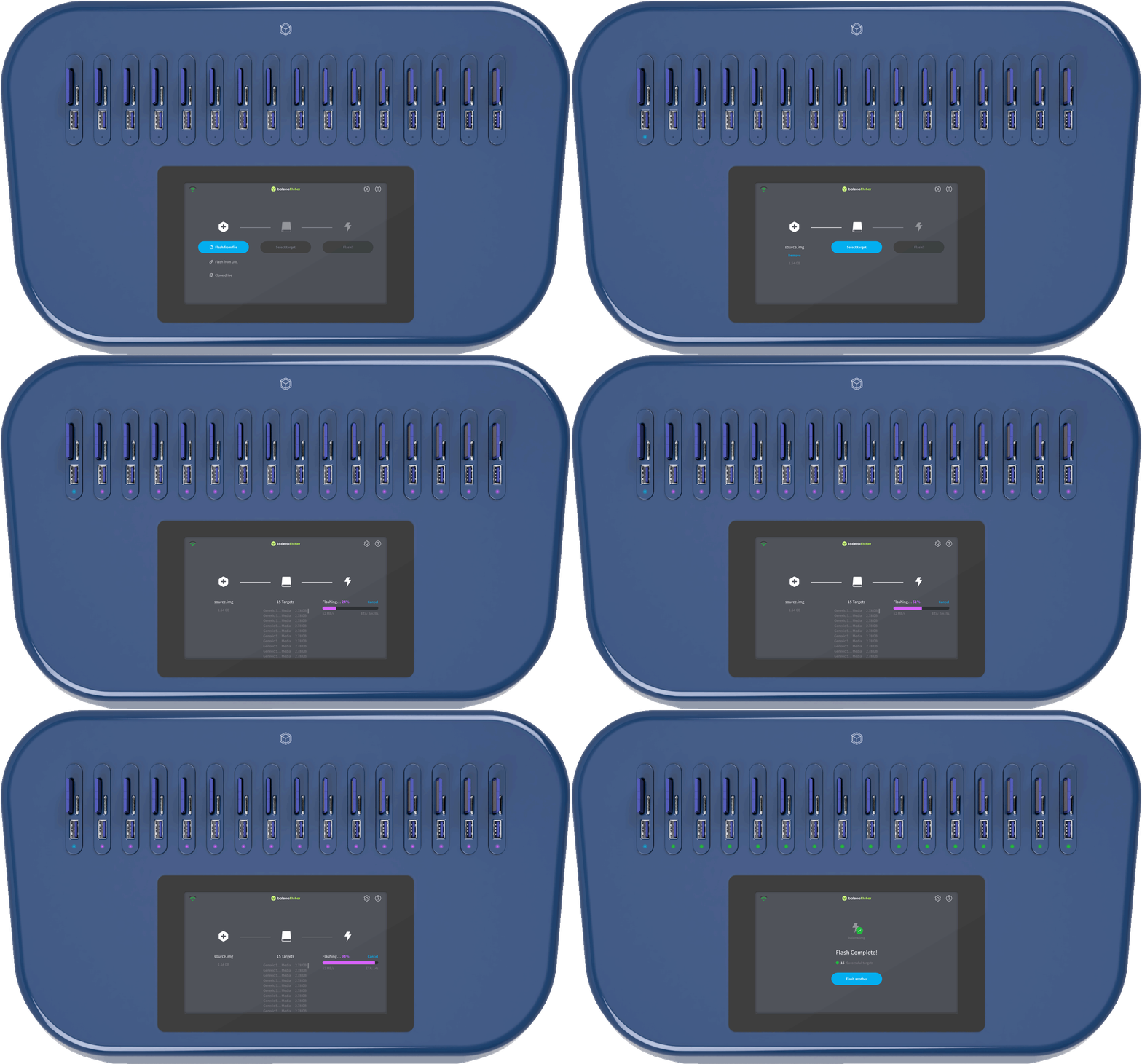
Every EtcherPro can flash up to 16 drives at a time if you are flashing from an online source. If you are flashing from a physical drive, you would be flashing up to 15 drives at a time, as the first slot would serve as the source. In the daisy-chaining scenario, you would only require one slot to serve as a source to flash the entire stack, when flashing from a physical drive.
EtcherPro offers USB (type A), SD and microSD interfaces by default, so you can flash up to 16 different drives / devices simultaneously. For instance, you can flash a balenaFin, a USB drive, an SD card and a microSD at the same time, as long as there is only one target per slot, and the source being flashed is the same for all target types.
EtcherPro supports USB (type A), SD and microSD interfaces, and can also flash single-board computers that are capable of being flashed via USB, as long as they are supported by Etcher. You can flash compute modules through carrier boards, for instance, flashing a Raspberry Pi CM3 through a balenaFin.
EtcherPro runs our open-source data-flashing software, Etcher, which can flash any kind of data. If you want to make sure that Etcher is capable of flashing your drive / device, you can download the latest version of Etcher and test it on your system to ensure compatibility.
When writing 16 drives simultaneously, EtcherPro can write up to 52 MB/s per drive, while when writing just 1 drive, EtcherPro can reach up to 200MB/s, so long as the drive / device can support those flashing speeds.
Etcher has a feature known as ‘trimming’ which can potentially accelerate the flashing of certain images by avoiding writing unused parts of ext partitions. As a result, you effectively get a bonus on the flashing speed.
EtcherPro flashes all target drives simultaneously, as such, the speed is determined by the drive that writes slowest. If you flash 1 drive that writes slowly, and 15 fast ones, the slow drive will determine the overall write speed. To account for this, make sure that all the drives, including the source drive (if any), can write at least as fast as EtcherPro flashes (52MB/s for 16 drives). Oftentimes, the advertised speed for a drive is the reading speed, rather than the writing speed (which is much slower). If you are sure your setup is up to spec and you still have issues please contact us.


.webp)